Boilers, explained
A boiler heats water, not air — and then circulates that water through radiators or baseboards, where the heat leaves it and enters the room. There are no ducts anywhere, and no blower pushing air at you.
A furnace heats air and needs ducts. A boiler heats water and needs pipes. Different repairs entirely.
Separate appliance, separate water. Unless you have a combi boiler, which deliberately does both.
A sealed loop held near 12 psi, with a relief valve that opens around 30. The gauge tells you most of what is wrong.
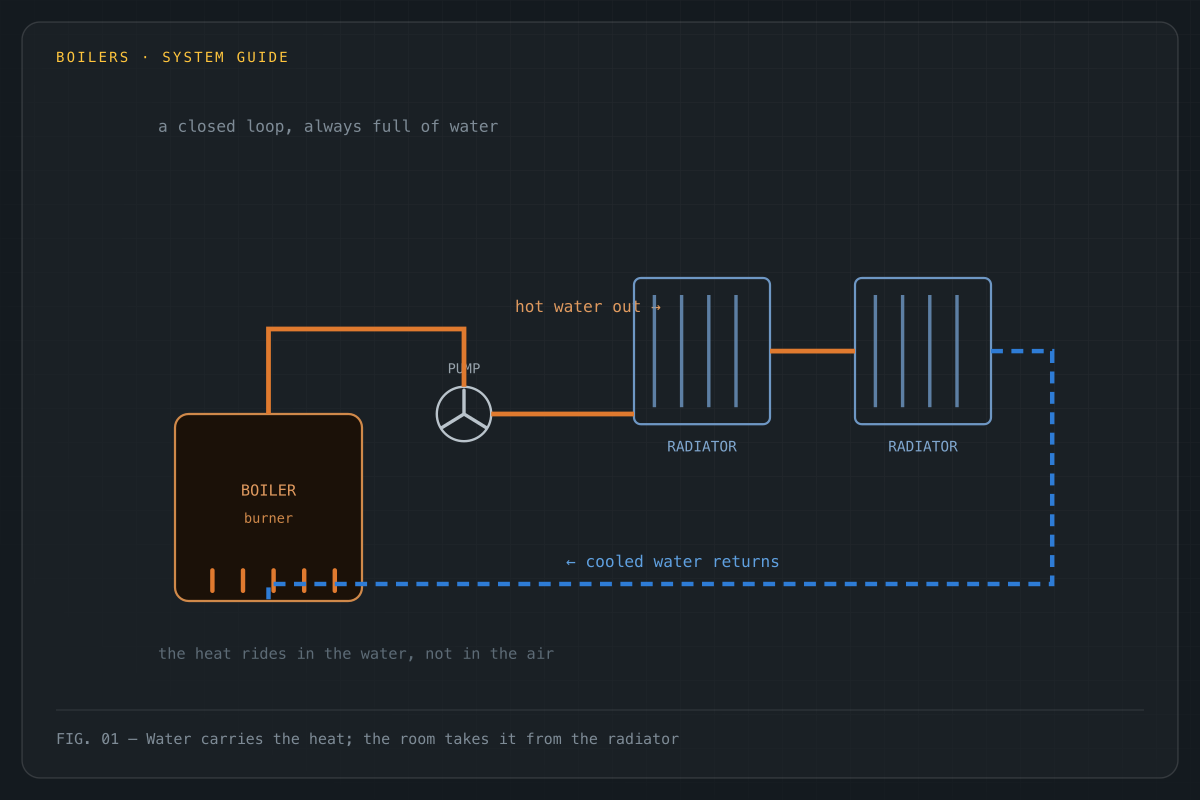
What a boiler is, and why it shares nothing with a furnace
A boiler is a water heater for your house. The water is the delivery van; the radiator is where it drops the parcel.
Forced-air heating conditions air centrally and then spends real energy pushing it through sheet metal to every room. Hydronic heating — the proper name for what a boiler does — heats water instead, and lets a small pump move it through pipes an inch across. Water carries far more heat per unit of volume than air does, which is why the pipes can be small and the pump can be quiet.
On this page
The practical consequence is that almost nothing transfers. A boiler has no ducts, no blower, no air filter, and no heat exchanger separating exhaust from the air you breathe in the way a furnace does. It has pipes, a pump, valves, and a pressure gauge. When a boiler fails, the questions a technician asks are different, and so are the ones worth asking yourself.
Steam or hot water? Find out before you read anything else
These are two different machines that both get called "the boiler," and nearly every piece of advice online applies to only one of them.
Steam
- The boiler boils water into steam, which rises through the pipes under its own pressure. No pump anywhere.
- Look for a sight glass — a short vertical glass tube on the side, showing a water level.
- Radiators usually have one pipe and a small air vent that hisses on the side.
- A low-water cutoff is mandatory, and the pressure is measured in ounces, not the 12 psi below.
Hot water (hydronic)
- The boiler heats water to perhaps 160–180°F and a circulator pump pushes it around a sealed loop.
- No sight glass. There is a pressure gauge reading around 12 psi cold.
- Radiators or baseboards generally have a pipe at each end, and a bleed valve at the top.
- Everything in the next three sections is about this system.
Steam systems are largely a pre-war inheritance and they are genuinely specialised — the good ones are quiet and comfortable, the neglected ones bang like a drum. Hot-water systems are what almost every boiler installed in the last fifty years is. If you saw a sight glass, stop and find a technician who says the word "steam" without flinching, because a great deal of general boiler advice will actively mislead you.
The parts, and what each one does when it dies
The boiler makes heat. Everything else exists to move that heat, or to stop the pressure doing something regrettable.
| Part | What it does | Where | What you notice when it fails |
|---|---|---|---|
| Burner & heat exchanger | Burns fuel and passes the heat into the water, never into your air | In the boiler | No heat at all; soot; a lockout that keeps returning |
| Circulator pump | Pushes hot water around the loop to the radiators | On the piping | The boiler gets hot, the radiators stay cold |
| Expansion tank | A cushion of air that absorbs water's expansion as it heats | Near the boiler | Pressure climbs on every cycle and the relief valve drips |
| Pressure relief valve | Opens at about 30 psi to protect the whole system | On top of the boiler | Water on the floor — a symptom, almost never the fault itself |
| Pressure-reducing valve | Feeds fresh water in to hold the cold system near 12 psi | On the fill line | A system that slowly loses pressure, or slowly gains it |
| Aquastat | The thermostat of the boiler itself — decides how hot the water gets | On the boiler | Short cycling, or water that never reaches temperature |
| Zone valves | Open and close to send hot water to one part of the house | On the manifold | One floor heats, another never does |
| Low-water cutoff | Kills the burner if the water level falls — mandatory on steam | On the boiler | A hard lockout, and a very good reason not to bypass it |
| Air vents / bleed valves | Let trapped air escape so water can reach the whole radiator | On each radiator | A radiator hot at the bottom and cold at the top |
Read the fourth row carefully. The pressure relief valve is the part homeowners see failing, and it is almost never the part that failed. Water on the floor beneath it means the pressure got to 30 psi, and the interesting question is why.
The pressure gauge tells you most of what is wrong
Twelve cold, a few psi more when hot, thirty at the relief valve. Those three numbers diagnose an enormous share of boiler calls.
A hot-water boiler is a closed loop, permanently full, with nowhere for the water to go as it expands. Every symptom below follows from that single physical fact, and the gauge on the front of the boiler is reporting on it continuously. Almost no consumer page explains what it is saying.
- Cold, the gauge should read about 12 psi
A hot-water boiler is a sealed loop. When the system is cold, the pressure-reducing valve holds it near 12 psi — enough to push water to the top-floor radiators and no more.
What it meansWell below 12 psi cold, and the upper floors will not heat. Bleeding a radiator drops pressure, so check the gauge afterwards.
- Hot, it rises — and that is normal
Water expands as it heats. A working system climbs a few psi during a firing cycle and settles back as it cools.
What it meansA rise of a few psi is fine. A climb toward 30 is not.
- The expansion tank absorbs that rise
A rubber diaphragm separates water from a pocket of air pre-charged to roughly 12 psi. The air compresses; the pressure stays sane.
What it meansWhen the diaphragm fails the tank fills with water — "waterlogged" — and there is nothing left to absorb the expansion.
- At about 30 psi the relief valve opens
It dumps water onto the floor rather than let the system burst. It is the last line of defence, and it is doing its job.
What it meansA dripping relief valve is usually a failed expansion tank, not a failed valve. Replacing the valve alone fixes nothing.
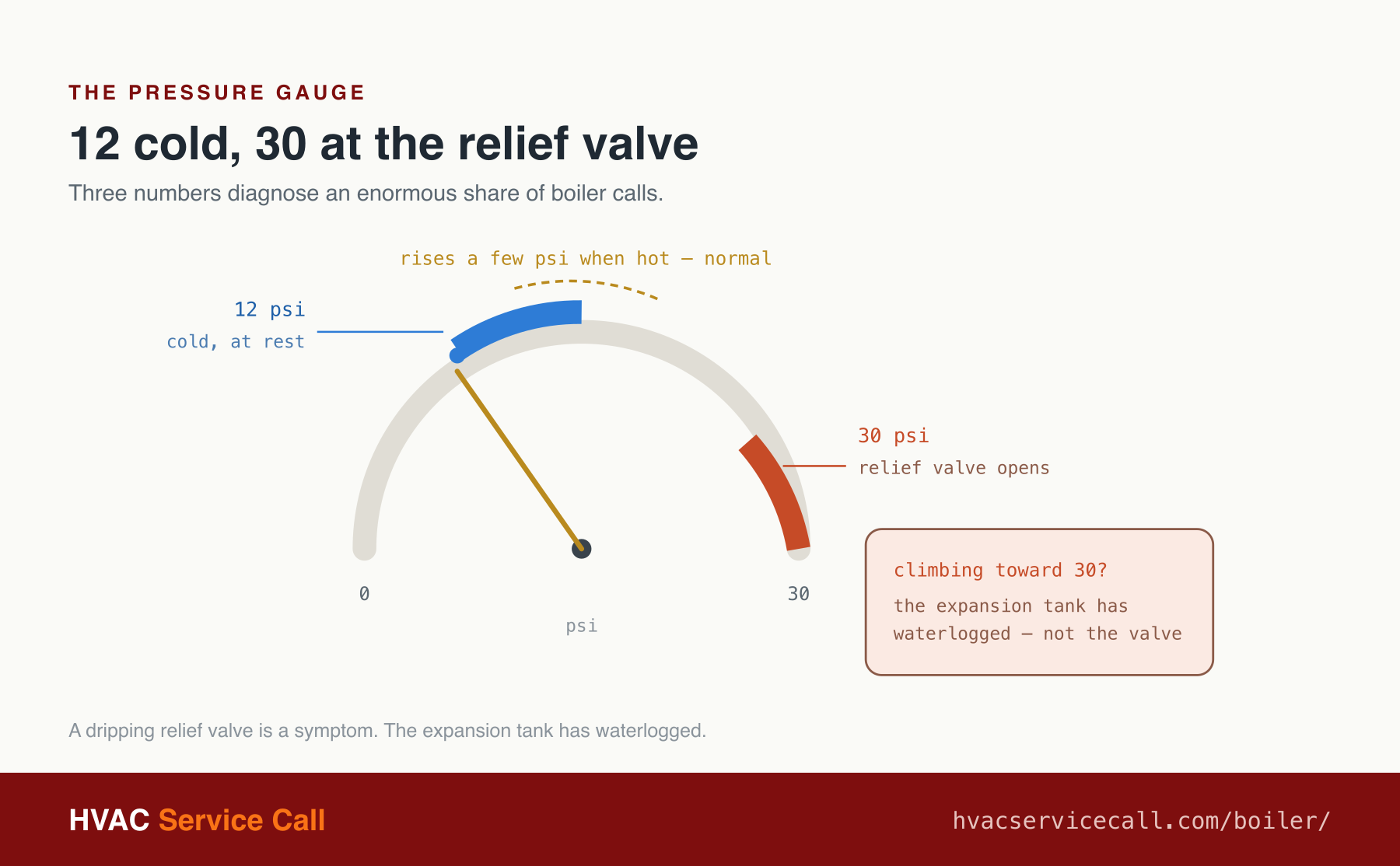
A dripping relief valve looks like a bad valve, and plumbers are sometimes asked to swap it. The valve is a symptom. Nine times in ten the expansion tank has waterlogged, the loop has nothing left to absorb thermal expansion, and the pressure climbs to 30 psi on every firing cycle. Replace the valve and the new one will drip too. Test the tank first — and if the pressure ever reads high while the boiler is cold, stop and call rather than experiment.
Cold at the top: air, and how to get rid of it
A radiator that is hot at the bottom and cold at the top has air trapped in it. This is one of the few boiler repairs that is genuinely yours.
Air enters a hydronic loop over time — dissolved in the fill water, drawn in through microscopic leaks, released as the water heats. It collects at the high points, which are the tops of your radiators, and water cannot reach the space it occupies. The radiator heats where the water is and stays cold where the air is, and the room never gets warm.
The fix is bleeding. With the system running, hold a cloth under the small bleed valve at the top of the radiator and open it slowly with a bleed key or a screwdriver. Air hisses out. When steady water arrives instead, close it. Work through the house from the radiator nearest the boiler outward, and finish on the highest floor.
Every bleed releases water as well as air, so system pressure falls. Bleed several radiators and you can drop the loop below the point where water still reaches the top floor — which produces exactly the cold radiators you were trying to fix. Read the gauge when the system is cold and bring it back toward 12 psi. If you are bleeding radiators every season, you do not have an air problem. You have a leak, and it wants finding.
Efficiency, and what condensing changes
Boilers are rated in AFUE, exactly as furnaces are. Crossing 90% means the exhaust condenses, and that changes the plumbing.
AFUE is the share of fuel that becomes useful heat rather than leaving up the flue. A conventional boiler lands somewhere in the 80s. A condensing boiler pulls enough heat out of its own exhaust that the water vapour inside condenses back to liquid, which lifts efficiency past 90% and lets the exhaust leave through plastic pipe instead of a metal flue. As on a furnace, that condensate is acidic and needs a drain.
There is a catch that matters more on boilers than on furnaces. A condensing boiler only condenses when the water returning to it is cool enough — broadly, below about 130°F. Radiant floors and modern baseboard run cool and let it condense most of the season. Big cast-iron radiators sized for 180°F water often do not, and a condensing boiler bolted to them can spend the winter running as an expensive conventional boiler. The equipment is not at fault; the system it was dropped into is.
When it stops heating: symptom, likely cause, where to read next
Boiler faults sort cleanly into two families — the heat is not being made, or the heat is not being moved.
| What you notice | Likely cause | Check yourself first | Read next |
|---|---|---|---|
| No heat anywhere, boiler cold | Thermostat · power · gas supply · lockout | Thermostat batteries, the switch on the boiler, the breaker | Troubleshooting → |
| Boiler is hot, radiators are cold | Circulator pump · zone valve · air lock | Can you hear or feel the pump running? | Boiler repair → |
| Radiator hot at the bottom, cold at the top | Trapped air | This one is yours — bleed it, then check the pressure | Troubleshooting → |
| Water dripping from a valve on the boiler | Waterlogged expansion tank raising pressure | Read the gauge. Is it near 30 psi when hot? | Boiler repair → |
| Pressure keeps falling and needs topping up | A leak somewhere in the loop | Look for damp under radiators and at pipe joints | Boiler repair → |
| One floor heats, another never does | Zone valve · zone thermostat · circulator | Does the pipe leaving that zone valve get warm? | Boiler repair → |
| It fires, runs briefly, stops, repeats | Short cycling — oversizing, aquastat, or low flow | Time the cycles before you call; it helps enormously | Boiler repair → |
| Banging or knocking in the pipes | Trapped air · steam meeting condensate · pipe expansion | Note whether it bangs on start-up or shut-down | Troubleshooting → |
Bleeding radiators, reading the gauge, checking the thermostat and finding the boiler's own switch are yours. The gas train, the burner, the heat exchanger and anything requiring the boiler to be drained belong to a licensed technician. Two rules have no exceptions. Never bypass a low-water cutoff — on a steam boiler it is the device standing between you and a dry-fired pressure vessel. And never cap, plug or block a pressure relief valve that is dripping; it is telling you the pressure is too high, and it is the only thing preventing that pressure from finding another way out.
If the house is cold and dropping right now, work the no-heat survival guide while you wait.
How long it lasts, and what keeps it there
15 to 30 years, and often beyond — boilers routinely outlive the furnaces installed the same year.
A boiler has no blower to seize, no ductwork to leak, and no air filter to strangle it. The parts that wear are the ones bolted around it — pumps, zone valves, expansion tanks, controls — and every one of them can be replaced without disturbing the boiler itself. That is why a cast-iron boiler with a failed circulator is a repair, not a replacement, in a way that a twenty-year-old furnace with a cracked heat exchanger is not.
Yours, no tools required
- Read the pressure gauge once a month in heating season. Cold, it should sit near 12 psi.
- Bleed a radiator that is cold at the top — then check the gauge again.
- Watch the floor under the relief valve. The first drip is early warning, not an emergency.
- Keep the boiler room clear, and never store anything against the boiler.
The technician's annual visit
- Test the expansion tank's air charge — the check that prevents the dripping-valve call.
- Clean the burner and inspect the heat exchanger; check draft and venting.
- Exercise the zone valves and check the circulator.
- On steam: flush the low-water cutoff, and skim the boiler if it is surging.
Book the annual tune-up, or read our unbiased take on maintenance agreements. When the boiler section itself finally goes, the arithmetic lives on repair or replace — and it is worth running properly, because a boiler that has lasted thirty years may have another decade in it.
Everything about your boiler
Boiler repair →
The faults we route, the free checks, and what a visit looks like.
Boiler repair cost →
Part-by-part prices, the call-out charge, and what a service costs.
Boiler troubleshooting →
No heat, low pressure, cold radiators — what to check, in order.
Boiler replacement →
When a fix stops making sense, and what a new boiler involves.
Heating systems →
How a boiler compares with the other ways to heat a house.
Furnaces →
The forced-air alternative — heats air, not water, and needs ducts.
HVAC repair cost →
What common heating repairs actually run, part by part.
Repair or replace →
Boilers last a long time, which changes the arithmetic.
No heat right now →
The survival guide, for while you wait for a contractor.
One call routes you to a licensed local HVAC contractor for boiler repair, 24/7, nationwide: (888) 810-2291 — or start at boiler repair.
Same-day and 24/7 emergency services are subject to provider participation, location, technician availability, and demand. Availability is not guaranteed and may vary by market and appointment capacity.
Common questions
What is a boiler, and how is it different from a furnace?
A boiler heats water and sends it around the house to radiators or baseboards, where the heat leaves the water and enters the room. A furnace heats air and blows it through ducts to vents. They share almost nothing: no ducts, no blower, and an entirely different set of parts and repairs.
Do I have a steam boiler or a hot-water boiler?
Look for a sight glass — a small vertical glass tube on the side of the boiler showing a water level. That means steam. A hot-water system has no sight glass but does have a pressure gauge reading around 12 psi when cold, and a circulator pump on the pipework. Steam radiators usually have one pipe and a small air vent on the side; hot-water radiators and baseboards generally have a pipe at each end.
What pressure should my boiler be at?
On a residential hot-water system, roughly 12 psi when the water is cold, rising a few psi as it heats. The pressure relief valve is set to open at about 30 psi. If your gauge climbs toward 30 during a firing cycle, something is wrong — most often the expansion tank.
Why is water dripping from my boiler's relief valve?
Because the pressure reached about 30 psi and the valve did exactly what it exists to do. The usual root cause is a waterlogged expansion tank: its internal diaphragm has failed, the tank has filled with water, and there is no longer an air cushion to absorb the expansion as the water heats. Replacing the relief valve without fixing the tank simply moves the problem.
How do I bleed a radiator?
With the system running and the radiator hot at the bottom but cold at the top, hold a cloth under the small bleed valve at the top of the radiator and open it slowly with a key or screwdriver. Air hisses out; when steady water appears, close it. Bleeding releases pressure from the system, so check the boiler gauge afterwards and top up toward 12 psi cold if needed.
Why is my boiler hot but the radiators are cold?
The heat is being made but not moved. On a hot-water system that points at the circulator pump, a stuck zone valve, or a large air lock in the piping. It is a different failure from a boiler that never fires at all, and knowing which one you have shortens the visit considerably.
How long do boilers last?
Commonly 15 to 30 years, and cast-iron boilers in well-maintained systems have run far longer. They generally outlive furnaces, because there is no blower and no ductwork, and because the components that do wear — pumps, valves, controls — are replaceable without touching the boiler itself.
What is a condensing boiler?
One that extracts so much heat from its own exhaust that the water vapour in it condenses, which pushes efficiency above 90% AFUE. Like a condensing furnace, it needs a drain for that condensate and vents through plastic pipe rather than a metal flue. It also depends on lower water temperatures to condense at all, which is why it suits baseboard and radiant floors better than it suits old cast-iron radiators.