Furnace repair in Bowling Green, KY
Looking for furnace repair in Bowling Green, KY? Call (888) 810-2291 — one free call routes you to a trusted, licensed local contractor for 24/7 no-heat service. Repairs typically cost $90–$540, with a $70–$180 diagnostic usually credited toward the work. The network covers all of Bowling Green — Downtown, Plano, Cave Mill, Hartland, Greenwood, Rockfield — and every Warren County ZIP, including 42101, 42103, 42104, and 42159.
Why do furnaces fail when Bowling Green gets cold?
Bowling Green works a genuine heating season: 3,729 heating degree-days a year against an 11°F winter design low (Open-Meteo climate normals). Furnaces here run a long, cold stretch, and the failures cluster on the first real freeze, when an igniter that cracked over the summer or a flame sensor coated in a season of dust meets its first genuine load test.
One honest caveat frames this whole page. Most Bowling Green homes don't run a gas furnace at all — 55% heat with electricity against 38% on gas (U.S. Census ACS 5-year), so this is a heat-pump-and-electric city with a real gas minority. If you own a gas furnace, everything below — igniters, flame sensors, the heat exchanger, and the carbon-monoxide stakes — applies directly to you; if you heat electric, the heat pump page fits better. The city's newer housing (median build 1991) means the gas furnaces still in service are largely 1990s–2000s units now aging out.

What are the signs your Bowling Green furnace needs repair?
Six signs cover most winter calls here — each links to its troubleshooting guide so you can narrow it down before dialing. The last is different in kind: gas odors and CO alarms are evacuate-first situations, never self-checks.
Behind every symptom is a specific part — the scope list next shows all of them, gas and electric alike.
What furnace repairs do Bowling Green contractors handle?
Thirteen repair types cover the full furnace scope — the gas side for the minority who run one, and the electric-furnace side for the many homes that heat that way. Common ones are priced in the cost section; each entry notes same-visit versus ordered-part.
- Flame sensor cleaning or replacement
- The lights-then-dies gas classic — a sooted rod stops sensing flame and the safety cuts the gas. Minor, same-visit, and the most common gas-furnace no-heat fix.
- Hot-surface igniter
- Clicks without ignition on a first cold morning. Truck stock and quick — typically the smallest bill among the true no-heat fixes.
- Gas valve replacement
- No gas despite a glowing igniter. Safety-critical and licensed-tech-only; a combustion check closes the job.
- Pressure switch
- The furnace won't start its sequence because draft can't be proven — check the vent before blaming the switch. Same-visit diagnosis.
- Limit switch
- Heat in short bursts, then shutdown: the overheat safety tripping, almost always over airflow. The filter matters more than the part.
- Inducer / draft motor
- Rattle or whine before ignition; no draft, no start. On the older sealed-combustion units here, this part is ordered more often than stocked.
- Heat exchanger inspection & condemnation
- The gas-only safety call — a confirmed crack retires the furnace. Evidence on camera or a combustion reading is a fair ask before you accept it.
- Electric heating elements
- The all-electric no-heat call: one failed element bank means weak, cool airflow. Relevant on the majority of Bowling Green homes on electric heat; usually same-visit.
- Sequencer replacement
- The stager that brings electric elements online in steps — stuck open means weak heat, stuck closed trips breakers. A modest electric-furnace repair.
- Blower motor & wheel
- Warm furnace, weak vents — fails on gas and electric units alike. ECM motors get ordered; PSC motors often ride the truck.
- Control board
- Blink codes, intermittent starts, dead low-voltage circuits. Typically a return-trip repair on any brand.
- Thermostat & low-voltage wiring
- A blank stat or chewed wire imitating a dead furnace — the mildest outcome on the list, fixed same-visit.
- Flue & venting repair
- Blocked or corroded venting is a carbon-monoxide pathway on gas units; it's inspected in the same combustion check that clears any gas-side job.
Every type above rides the same dispatch line, whatever the hour — and the common ones are priced just below.
Broken furnace in Bowling Green, KY?
Clicks-but-won't-light, lukewarm air, nothing at all — say what it does and a licensed Bowling Green contractor handles the rest. The call itself costs nothing.
☏ Call (888) 810-2291Availability is subject to provider participation, location, technician availability, and demand.
What should you check before calling for furnace repair?
Five checks catch the false alarms — the flipped switch, the dead thermostat, the suffocating filter — before you pay for a visit. What they never include: the burner compartment, the gas line, or anything behind the electric furnace's high-voltage panel.
- Thermostat: heat mode, setpoint above the room, fresh batteries — a blank thermostat imitates a dead furnace perfectly.
- Filter: a long heating season clogs filters by midwinter; a gray filter overheats the furnace into shutdown.
- Power switch & breaker: the switch beside the unit gets bumped off in basement and closet mechanical rooms; check it first, then the breaker.
- Fuel supply: gas home: confirm other gas appliances light. All-electric home — the majority here: look for a second tripped breaker, since electric furnaces often run two.
- High-efficiency drain: condensing furnaces shut down on a frozen or blocked condensate line; in an 11°F cold snap that line can freeze — thaw and clear it.
Who fixes furnaces in Bowling Green, KY?
Tell the technician which checks you already cleared — it trims the diagnosis. A licensed Bowling Green furnace tech is one free call away, day or night.
☏ Call (888) 810-2291Availability is subject to provider participation, location, technician availability, and demand.
What does furnace repair cost in Bowling Green?
Contractors here charge $70–$180 to diagnose, and that fee typically comes off the final invoice when you approve the work — the service-call fee guide explains the mechanics. Completed repairs mostly land between $90–$540, and the failed part sets the number: flame sensors and limit switches at the floor, blower motors in the middle, the heat exchanger at the ceiling.

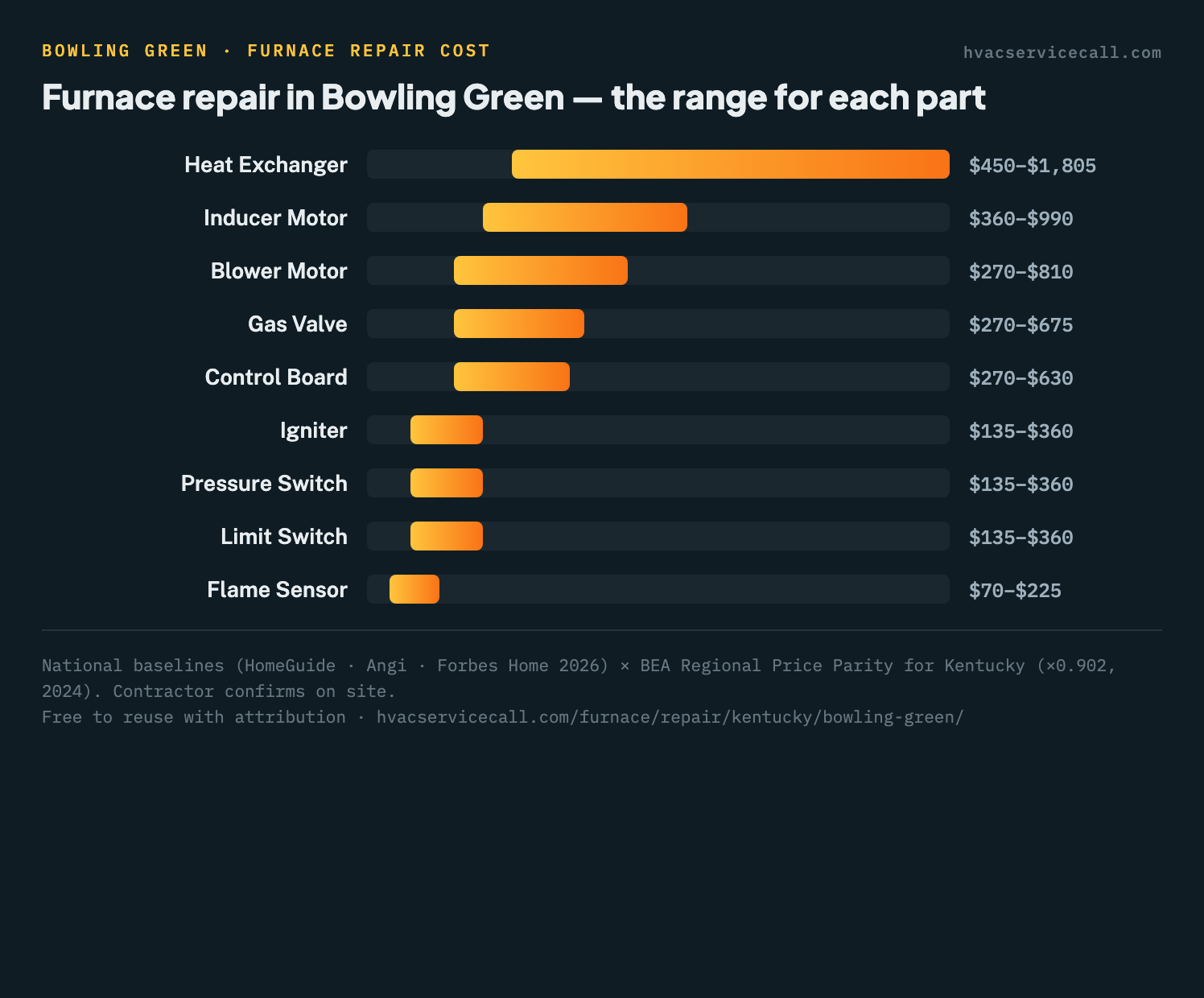
| Repair | Low | Typical | High | Note |
|---|---|---|---|---|
| Diagnostic / service call | $70 | $125 | $180 | normally folded into the repair bill |
| Heat Exchanger | $450 | $1,130 | $1,805 | the gas-side dealbreaker; demand to see it |
| Inducer Motor | $360 | $675 | $990 | ordered for older sealed-combustion units |
| Blower Motor | $270 | $540 | $810 | the one part both fuels share |
| Gas Valve | $270 | $475 | $675 | combustion work, never a DIY item |
| Control Board | $270 | $450 | $630 | an ordered part on most boards |
| Igniter | $135 | $250 | $360 | the cold-snap morning no-start |
| Pressure Switch | $135 | $250 | $360 | look at the vent run first |
| Limit Switch | $135 | $250 | $360 | a dirty filter keeps tripping it |
| Flame Sensor | $70 | $150 | $225 | a cleaning usually beats a swap |
| Typical repair, all parts | $90 | $210 | $540 | the band most no-heat calls close in |
| After-hours service call | $105 | $235 | $360 | ≈1.5–2× on nights and holidays |
| Furnace replacement (installed) | $3,430 | $6,000 | $8,570 | the ceiling every big quote is judged against |
How we price this: the Bureau of Economic Analysis publishes an official price level for every state, and Kentucky's 2024 figure runs about 9.8% under the U.S. average — that, not our judgment, is the ×0.902 applied to national baseline ranges from HomeGuide, Angi, and Fixr. Phone quotes aren't honest quotes: the real number is set on site after diagnosis. In the Typical column, the overall-repair row uses the sources' published average (adjusted identically); part rows show the midpoint of the local range, offered as a planning figure since no survey average exists per part. Replacement math lives at furnace repair vs replacement cost.
Two keystrokes short of a dispatch — try your ZIP
Dispatch runs street by street across Warren County. Confirm your ZIP is on the map, then make the call with the range above as your yardstick.
In a hurry? Call (888) 810-2291 now.
Licensed contractors serve . One call routes you to one for .
☏ Call (888) 810-2291Availability is subject to provider participation, location, technician availability, and demand.
What makes furnace repair cost more or less in Bowling Green?
Five factors account for most of the distance between the floor and the ceiling of that table.
- Which part failed
- the spread is the part: a flame-sensor clean sits near $70, a heat exchanger reaches $1,805.
- Gas vs. electric
- gas furnaces — the minority here — carry combustion parts (igniter, valve, exchanger) an electric furnace never has to fail; electric units, which heat most Bowling Green homes, trade those for elements and sequencers.
- Age of the unit
- Bowling Green's median home dates to 1991, the newest stock we cover — so the failures now are 1990s–2000s furnaces reaching the end of their design life, not neglected antiques.
- Access
- basement and closet mechanical rooms are tight; converted attic units add labor time.
- After-hours
- a night, weekend, or holiday dispatch typically runs 1.5–2× the standard visit fee.
How long does furnace repair take in Bowling Green — and what happens on the visit?
The technician's first ten minutes look like your pre-call checklist — thermostat, power, filter — then the work splits by fuel: on gas, the ignition chain (sensor, igniter, valve, pressure switch) and the heat exchanger; on electric, elements, sequencers, and the blower circuit. Diagnosis runs 5 to 60 minutes and ends in a written quote; nothing is replaced before you approve it. Truck-stock parts — igniters, sensors, capacitors, most sequencers — put heat back within the hour. Blower motors, boards, and exchanger inspections stretch to several hours, and an ordered part means a return trip, usually one to three days.
What speeds it up: a clear path to the unit and a precise description of the failure. "Clicks four times then quits" and "runs but blows cool" point at different parts before the panel ever comes off.
Why Bowling Green is an electric-heat city — and what that means for your furnace
Bowling Green flips the usual Kentucky pattern: 55% of Warren County homes heat with electricity against 38% on gas (U.S. Census ACS 5-year). In practice most heating calls here are heat pumps and electric furnaces — elements, sequencers, blowers — with a steady minority of gas-furnace work: igniters, flame sensors, gas valves, and the heat exchanger. That minority is exactly who this page's combustion-safety section is written for; if you're in the electric majority, your no-heat risk is the heat pump's balance-point story, not a cracked exchanger. Electricity here runs about 13.24¢/kWh through BGMU or Warren RECC.
For the gas minority, though, the safety rules in the next section are squarely the point.
Carbon monoxide and the heat exchanger — the gas-furnace failure that's a safety issue
For the Bowling Green homes that do run gas heat, one failure outranks every other: a cracked heat exchanger. That sealed chamber is the only barrier between your supply air and the combustion gases — including carbon monoxide, which is odorless, colorless, and announces itself as flu symptoms without a fever: headache, dizziness, nausea. Metal fatigue cracks it with age, and a gas furnace working through 3,729 heating degree-days a season builds that fatigue over time.
A confirmed crack is the end of the furnace, not a repair — an exchanger can't be safely welded back into service. Put a CO detector on every level and near bedrooms, test it each fall, and have the exchanger looked at during the annual tune-up. If the alarm sounds: evacuate first — phones can wait until you are outside. Then it is the gas utility and 911, and only after that the repair call. For a live no-heat crisis, the Bowling Green emergency page covers triage.
When is a furnace problem an emergency in Bowling Green?
Against an 11°F design low, a dead furnace in January is urgent in any Bowling Green home, and dangerous in homes with newborns, oxygen concentrators, or bedridden family members — which is exactly what to say when you call, because it moves the dispatch queue. A lengthy no-heat spell also risks frozen pipes. Gas smell or CO alarm outranks everything: door first, then the utility and 911 from the sidewalk, repair call last.
A search for “furnace repair near me” in Bowling Green lands by location, so calls from Downtown, Plano, Cave Mill, or Hartland — 42101, 42103, 42104, and the rest of Warren County — reach a company routed to you by ZIP code.
Does homeowners insurance cover furnace repair in Bowling Green?
Not for the repair you'll most likely need. Standard policies draw one line: covered perils — fire, lightning, a burst pipe drowning the mechanical room, a tree through the roof, storm damage — are paid under dwelling coverage minus the deductible; wear, age, and mechanical breakdown — the failed igniter, the burned-out element, the tired blower — are excluded (per Allstate and Progressive policy guidance). Nearly every furnace call lands on the excluded side.
The gap-closers: an equipment-breakdown endorsement, a cheap rider that covers mechanical failure, or a home warranty — a service contract with its own fine print, not insurance. Whichever route, keep tune-up receipts; both insurers and warranty firms ask for maintenance history before paying.
Which furnace brands do Bowling Green contractors repair — and how do they fail?
Brand rarely blocks a repair — part availability and the failed component decide. The cluster is the same across badges: igniters and flame sensors on gas units, elements and sequencers on electric, blower motors on both, and the heat exchanger as the gas-side deal-breaker. Higher-tier two-stage and modulating furnaces stack more electronics, so their faults skew toward boards and sensors; the simpler single-stage units fail on fewer, cheaper parts — but on the 1990s–2000s equipment common here, age is doing more work than brand, and part availability is the real scheduling risk.
Tier is market positioning — efficiency ceiling and parts cost — never a ranking; installation quality outweighs the badge. Source: manufacturer 2026 lineups; the rating plate on your unit settles model and age, and age is what the next section prices.
Is it worth repairing or replacing your Bowling Green furnace?
Multiply the repair quote by the unit's age — the $5,000 rule — and let the product decide: over 5,000 leans replace. A gas furnace runs 15–20 years, an electric furnace often longer. Because Bowling Green's housing is newer than most of Kentucky, a lot of gas furnaces here are reaching that window for the first time now, so a heat-exchanger verdict or a second major failure in two winters usually settles it — a new furnace installs for $3,430–$8,570 in Bowling Green, and in an electric-majority town a heat pump is often on the table as the replacement instead.
When should you schedule a furnace replacement in Bowling Green?
On your calendar, not the furnace's. Installer books empty out in the shoulder windows — late February through early March and September through mid-October — bringing quicker scheduling, room to compare quotes, and off-season pricing. The furnace's preferred date is the first hard freeze, with every installer in the area already booked. A unit past fifteen years that needed repairs two winters running is the textbook case for a planned October changeout.
What furnace rebates can Bowling Green homeowners get?
Bowling Green sits in Tennessee Valley Authority territory — served by BGMU inside the city and Warren RECC in the county — so incentives run through TVA EnergyRight (the eScore program), not the LG&E rebates other Kentucky cities use. There's no rebate for a like-for-like gas furnace, but a switch to a qualifying high-efficiency heat pump can earn one — a natural move in a town where most homes already heat electric. The amounts move with efficiency ratings and program updates and require a TVA Quality Contractor Network installer, so confirm the current figure directly with BGMU or Warren RECC. The federal 25C tax credit ended December 31, 2025, so the utility program is the incentive to check first.
Can you finance a furnace repair or replacement in Bowling Green?
A $90–$540 repair is card-sized; the $3,430–$8,570 replacement is where financing enters, and nearly every installer offers a 0% intro-APR promotion or a fixed-rate equipment loan. Gas furnace buyers finance close to the full quote — no utility rebate trims a like-for-like swap — while a heat-pump route may qualify for a TVA EnergyRight rebate against the price. The HVAC financing guide compares the offer types, deferred-interest traps included.
Do you need a permit or a licensed contractor for furnace work in Bowling Green?
Repairs, no. Replacements, yes — and Bowling Green has two permitting offices depending on where you live: inside the city limits, the mechanical permit for a changeout comes from the City of Bowling Green Building & Inspection Division; in unincorporated Warren County (excluding Bowling Green and Oakland), from Warren County Building Services. The residential fee is $75 for the first system plus $50 for each additional under 815 KAR 8:070, pulled by the contractor, with a five-business-day review. Gas equipment adds a combustion-safety check. The license side is statewide: work must be done through the Kentucky Division of HVAC (Department of Housing, Buildings & Construction) under 815 KAR 8:010, verifiable at dhbc.ky.gov; a Bowling Green contractor may also carry a local license from the Bowling Green/Warren County Contractors Licensing Board.
What should you ask a furnace contractor before approving the work?
Four questions before any repair: licensed and insured in Kentucky (run the license through dhbc.ky.gov)? Estimate written and itemized? Diagnostic fee credited against the work? Part still under manufacturer warranty? On a gas furnace add the evidence rule: a condemned heat exchanger should be shown to you — on camera or in a combustion reading — not merely announced. And before a replacement: a Manual J load calculation rather than copying the old tonnage, a duct-and-venting evaluation, and warranty terms that name labor, not just parts.
Walk away from phone-only replacement quotes, today-only pricing, big cash deposits, and any condemnation without evidence. Contractors who are legitimate treat the checklist as routine.
How can you prevent a furnace breakdown in Bowling Green?
A fall tune-up — roughly $75–$150 — is cheap insurance: it cleans the flame sensor, tests the igniter, and on gas units inspects the heat exchanger before the heating season leans on it. On an aging gas furnace that exchanger inspection is the part that matters most. The homeowner's half is the filter: through a 3,729-degree-day winter, a monthly change is what keeps the limit switch from turning airflow problems into no-heat calls.
Which other Bowling Green HVAC page do you need?
Gas is the minority fuel in Bowling Green — 38% against 55% electric — so this page speaks to a smaller share of the city than a furnace page usually would. The three below cover the majority system, the cooling season, and the storm night.
- Because most Bowling Green homes heat with electricity — Bowling Green heat pump repair is the city's majority heating system, and the page that carries the balance-point story at an 11°F design low.
- The same ductwork works harder in summer than in winter here — Bowling Green AC repair covers 1,648 cooling degree-days under a 95°F design high, and the drain clogs that follow.
- If it is the grid rather than the furnace — emergency HVAC in Bowling Green separates a power failure from an equipment failure, the distinction the December 2021 tornado made unforgettable here.
HVAC services in Bowling Green, KY — the city page: all four Bowling Green services, the BGMU and Warren RECC split, and the local cost ranges.
Where these numbers come from
Every figure on this page comes from a published dataset rather than an estimate. The sources are listed below with the vintage of each, so you can check any number yourself — and so you can see when a figure is due for a refresh.
- Degree-days & design temperatures Open-Meteo ERA5 · 2014-2023 normals · retrieved 2026-07-15
- Heating fuel mix & housing age Census ACS5 2022 (county) · Warren County, Kentucky table · retrieved 2026-07-15
- Residential electricity rate U.S. Energy Information Administration · state average, cents per kWh · retrieved 2026
- National cost ranges (before local adjustment) HomeGuide, Angi, Forbes Home, Fixr, HVAC Pro Sales, Carrier, corpus-observed 2026-07 · retrieved 2026-07-15
- Local price adjustment BEA SARPP all-items · all-items RPP, applied to the national range · retrieved 2026-07-30
- Contractor licensing & verification Kentucky Division of HVAC (Department of Housing, Buildings & Construction) · retrieved 2026-07-15
Cost ranges are national published ranges adjusted to local price levels, not quotes. The independent licensed contractor who takes the call sets the actual price, in writing, before any work begins.
Bowling Green furnace repair — questions homeowners ask
Do most Bowling Green homes even have a gas furnace?
No — and that's worth knowing before you diagnose anything. In Warren County, 55% of homes heat with electricity against 38% on gas (U.S. Census ACS 5-year), the reverse of much of Kentucky. So if you own a gas furnace, this page is squarely for you: igniters, flame sensors, gas valves, the heat exchanger. If you heat with a heat pump or electric furnace — the majority here — the Bowling Green heat pump page is the better fit, and either way (888) 810-2291 routes your ZIP to a licensed local contractor.
My Bowling Green furnace runs but the air is barely warm — what's wrong with it?
On a gas furnace, that's usually burners lighting and then dropping out — a sooted flame sensor is the classic cause. On an electric furnace it more often means one bank of heating elements has failed, so the blower moves air the rest can't fully warm. Either way the system limps instead of heating. Dial (888) 810-2291 and the line pairs your Kentucky ZIP with a licensed local contractor.
What does a furnace repair visit cost in Bowling Green?
Contractors charge $70–$180 to diagnose, and that fee typically comes off the final invoice when you approve the repair on the spot. Complete repairs mostly land in the $90–$540 band — a flame-sensor clean or limit switch at the low end, a blower motor or heat exchanger at the top.
My furnace is from the 1990s or early 2000s — is it living on borrowed time?
Possibly. Bowling Green's median home dates to 1991, the newest stock we cover, but a home built in that era on its original furnace is now looking at a unit 25–35 years old — past a gas furnace's typical 15–20 years, though electric furnaces often run longer. Find the manufacture date on the rating plate; past year fifteen, budget with the $5,000 rule in mind rather than repairing indefinitely, and treat a heat-exchanger inspection as non-optional on an aging gas unit.
The first cold morning of the season and the furnace won't start — why does that happen?
Because the first hard freeze is the furnace's first real load test after months of idling. Igniters that cracked over summer, flame sensors coated in dust, and weak blower capacitors all pass a mild-October run and fail that first sub-freezing morning — and Bowling Green's design low is 11°F over 3,729 heating degree-days, so the freeze does arrive. A fall tune-up moves the discovery to a scheduled visit instead of the coldest week.
Who do I call if I smell gas near the furnace in Bowling Green?
Leave the house first, then call your natural gas utility and 911 from outside, and only after that book the contractor. Never re-enter to open windows or flip switches — a phone or a light switch can ignite accumulated gas. (BGMU and Warren RECC provide electricity in the area, not gas, so the gas emergency line is your gas provider's, printed on your gas bill.)
Are there rebates if my old furnace has to be replaced in Bowling Green?
Not for a like-for-like gas furnace. But Bowling Green is TVA territory, so a switch to a high-efficiency heat pump can qualify for a TVA EnergyRight (eScore) rebate through BGMU or Warren RECC — a real consideration here, where most homes already heat electric. Amounts move with program updates and require a TVA Quality Contractor Network installer, so confirm the current figure with your utility. The federal 25C tax credit ended December 31, 2025, so the utility program is the live incentive to check.
A technician condemned my heat exchanger on the spot — do I have to take his word for it?
No. A cracked heat exchanger is a real, serious verdict — it retires the furnace — but it's also a known pressure-sales script, so ask for evidence: the crack on an inspection camera, or a combustion-analysis reading showing CO in the supply air. A legitimate technician shows you without friction. Because a $3,430–$8,570 replacement rides on the answer, a second diagnostic fee for a fresh opinion is cheap insurance.
My CO alarm sounded overnight — could the furnace really be the source?
If the home has gas heat, yes. A cracked heat exchanger or blocked flue lets combustion gases reach the living space, and carbon monoxide gives no smell or color, only flu-like symptoms without the fever. Evacuate first; phones can wait until you are outside. Then it is the gas utility and 911, and only after that the repair. An all-electric furnace or heat pump — what most Bowling Green homes run — produces no CO; look to gas water heaters, ranges, or an attached garage instead.
How fast can someone actually get to me during a Bowling Green cold snap?
You can call at 3 a.m.; whether a technician rolls out at 3 a.m. depends on who is on call in the area that night. In a hard freeze the queue is triaged, so homes with newborns, oxygen concentrators, or bedridden family members should say so up front, because that moves a no-heat call up the list. Most of the winter, same-day is realistic.
Will homeowners insurance ever pay for my furnace in Bowling Green?
Only when a covered peril did the damage — a burst pipe flooding the mechanical room, a house fire, lightning, storm damage. The everyday failure of an igniter, element, or blower is wear and tear, which standard policies exclude. An equipment-breakdown endorsement is the inexpensive add-on that closes exactly that gap; keep maintenance records either way.
Do I need a permit to replace a furnace in Bowling Green, and who issues it?
Yes — a replacement needs a mechanical permit, and which office issues it depends on where you live. Inside the city limits it comes from the City of Bowling Green Building & Inspection Division; in unincorporated Warren County (excluding Bowling Green and Oakland) it comes from Warren County Building Services. The residential fee is $75 for the first system plus $50 for each additional, pulled by the contractor. A straightforward repair needs none, and a replacement quote with no permit line is worth a question.
What should I have in hand before approving a big furnace repair quote?
A written, itemized estimate; confirmation the diagnostic fee is credited against the work; the unit's model and install date so warranty coverage can be checked; and — on an older unit — a replacement quote for comparison, judged by the $5,000 rule. The contractor's Kentucky license takes two minutes to verify at dhbc.ky.gov, and locally a Bowling Green contractor may also hold a city/county license.
Furnace repair coverage across Bowling Green, KY
From Downtown and Plano out to Hartland, Rockfield, and the Warren County line, dispatch reaches 10 ZIP codes covering Bowling Green and Warren County, and the neighborhoods below. However you searched — “furnace repair near me,” your ZIP, or your neighborhood by name — the Kentucky contractor who answers already works that ground.
Every Bowling Green-area ZIP on the routing list: