Furnace repair in Knoxville, TN
Looking for furnace repair in Knoxville, TN? Call (888) 810-2291 — one free call routes you to a trusted, licensed local contractor for 24/7 or same-day no-heat service. Repairs typically cost $90–$550, with a $70–$185 diagnostic usually credited toward the work. The network reaches every corner of Knoxville — Fountain City, Bearden, Halls, Powell, Sequoyah Hills, Farragut — and all 35 Knox County ZIPs, including 37918, 37912, 37909, 37922, and 37934.
Why do furnaces fail in Knoxville?
Knoxville is a heating-led city that asks surprisingly little of any single furnace: about 3,408 heating degree-days against a 16°F winter design temperature (Open-Meteo climate normals), yet only one month — January, with an average low near 31°F — actually sits below freezing. That combination is the whole story: the heating season is real, but a furnace here runs comparatively few hours, so it fails less from wear than from sitting idle between cold snaps.
Two local details sharpen it. Knox County's median home dates to 1984 (U.S. Census ACS 5-year), so a lot of gas furnaces are old enough for the heat-exchanger question to be live. And the natural gas itself comes from the Knoxville Utilities Board (KUB), the city-owned municipal that supplies both fuels — one provider for gas and electricity, which is unusual. The failure pattern that follows isn't heat-fatigue; it's the first-fire-of-the-season fault, and the sections below walk it part by part.

Which furnace problems show up most in Knoxville homes?
Eight signs cover most cold-weather calls here, each linked to a full troubleshooting guide. A no-flame first fire leads the list in this idle-system climate; any gas smell, a CO alarm, or a delayed ignition are leave-now or call-now items rather than wait-and-see.
A symptom narrows it to a part or two — the full scope of what actually gets repaired comes next.
What furnace repairs do Knoxville contractors handle?
Every residential gas-furnace repair type is in scope, from the five-minute flame-sensor clean to the heat-exchanger verdict that reopens the replacement question. The common ones carry Knoxville prices in the next section; each line flags whether the part usually rides the van or has to be ordered.
- Flame sensor clean or replace
- Knoxville's number-one no-heat: a season's oxidation blinds the sensor, the burner lights and drops out within seconds. Cleaned or swapped same visit, van stock.
- Hot-surface igniter
- The brittle ceramic element that lights the burners cracks with thermal age and won't glow — the classic first-fire failure. Usually aboard the van.
- Pilot & thermocouple (older units)
- On a standing-pilot furnace, a pilot that won't hold is a thermocouple or gas-valve fault. Van stock on common models.
- Pressure switch
- A safety that won't close on a lazy, post-summer inducer and locks the sequence out. Van stock, same visit.
- Limit switch
- The overheat cutout that trips on a clogged filter or blocked airflow, faking a dead furnace. Van stock.
- Inducer motor
- The draft blower that seizes or whines after months of dormancy; without proof of draft the furnace won't fire. Sometimes van stock, sometimes ordered.
- Gas valve
- Meters fuel to the burners; a failed valve means no heat and demands a combustion re-check afterward. Ordered part.
- Blower motor
- Moves the heated air; a dead blower trips the limit on a running burner. ECM versions wait on an order, PSC motors are often same-visit.
- Control board & relays
- Intermittent starts and ignored heat calls; typically ordered.
- Heat exchanger
- The safety core that separates combustion gases from your air — a crack leaks carbon monoxide and condemns the furnace rather than getting patched. The tallest bar on the cost chart.
- Flue & venting repair
- A blocked or corroded vent backs combustion gases up; cleared or resealed, often same visit.
- Thermostat & gas-line/electrical
- Miswired or failing thermostats swap before the tech leaves; gnawed low-voltage wire and switch faults are same-visit unless the trouble sits in the panel or the gas piping.
One line dispatches every one of these, whatever the hour — and the chart below prices the common ones for Knoxville.
Broken furnace in Knoxville, TN?
No flame, cold air from the vents, a click with no light: each points somewhere different, and the technician sorts it quickly. One free call, Knox-County-routed, 24/7.
☏ Call (888) 810-2291Availability is subject to provider participation, location, technician availability, and demand.
Before you call for furnace repair in Knoxville, what's worth checking?
Five checks clear the false alarms and cost nothing to run. None touches the burners, the gas valve, or the venting — that's licensed, combustion territory, no exceptions, and a gas smell ends the checklist immediately.
- Thermostat: heat mode, setpoint above the room, fresh batteries — rule out the trivial cause before anything else.
- Filter: a filter left in since summer chokes airflow and trips the limit switch into a no-heat lockout; if it's gray, change it and cycle the power.
- Breaker & switch: check the panel and the furnace's own service switch (it looks like a light switch by the unit) — a bumped switch mimics a dead furnace.
- Gas supply: confirm the gas valve at the furnace is open and other gas appliances work; if you smell gas, stop and call the gas line, not us.
- Vents & registers: open the supply and return registers — too many closed vents starves airflow and shuts the burner down on a limit trip.
Still cold after all five? The furnace troubleshooting guide goes deeper, or you hand it straight to a diagnosis.
Who fixes furnaces in Knoxville, TN?
Tell the technician which ones you already ruled out — thermostat, filter, switch, gas, registers — and the diagnosis starts a few moves ahead. Licensed Knoxville pros, any hour.
☏ Call (888) 810-2291Availability is subject to provider participation, location, technician availability, and demand.
What does furnace repair cost in Knoxville?
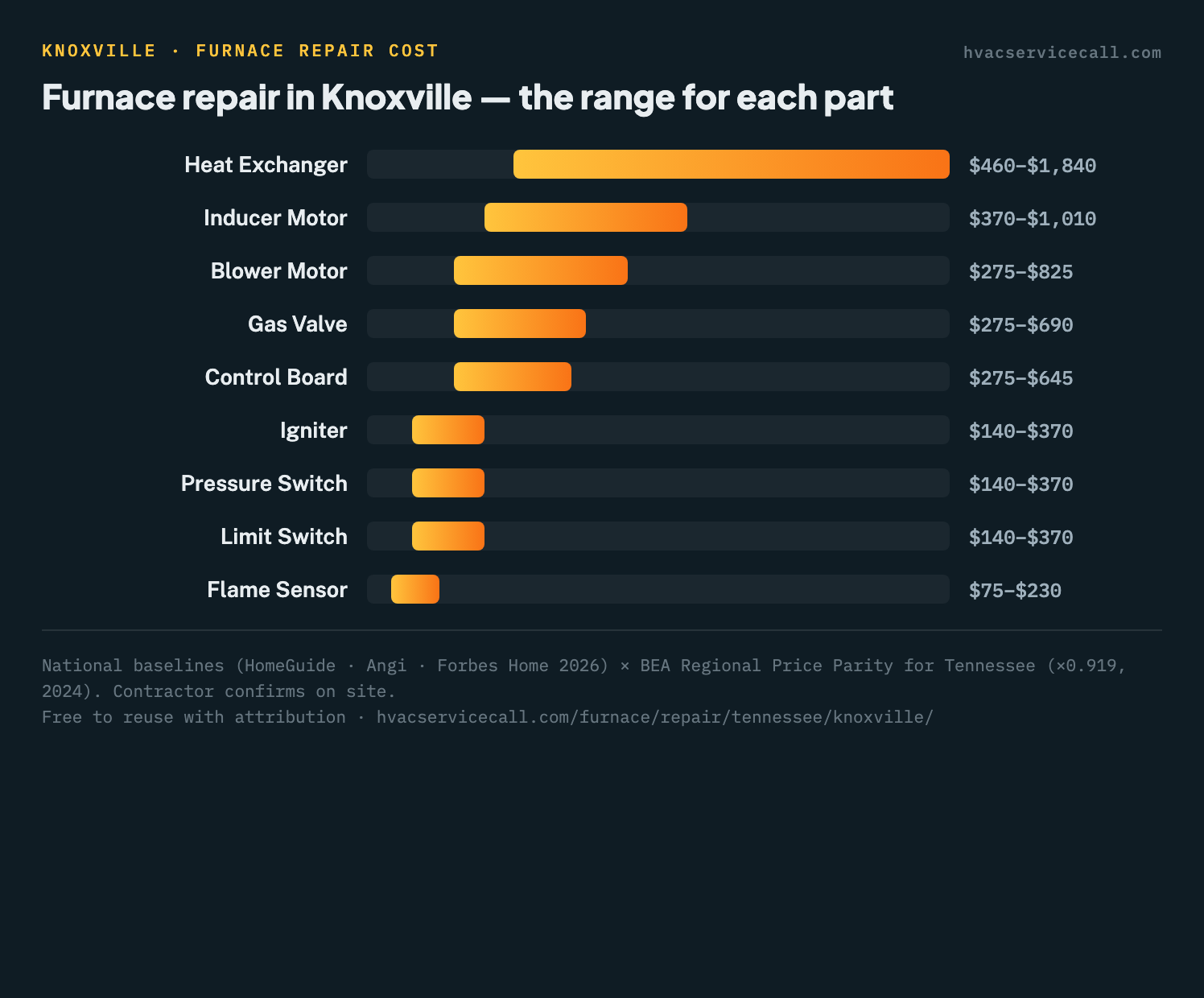
Set aside $70–$185 for the diagnostic visit itself — when the repair goes ahead, that money usually counts against the bill; the service-call fee guide explains how contractors handle it. Most finished Knoxville furnace repairs then land between $90–$550, and the failed part sets the spot on that range: flame sensors and igniters near the floor, a heat exchanger or gas valve up at the top.

| Repair | Low | Typical | High | Note |
|---|---|---|---|---|
| Diagnostic / service call | $70 | $130 | $185 | usually folded into the repair bill |
| Heat Exchanger | $460 | $1,150 | $1,840 | the safety part — usually where replacement wins the argument |
| Inducer Motor | $370 | $690 | $1,010 | seizes after a summer sitting dormant |
| Blower Motor | $275 | $550 | $825 | ECM versions have to be ordered |
| Gas Valve | $275 | $485 | $690 | ordered; combustion re-checked after |
| Control Board | $275 | $460 | $645 | ordered on most models |
| Igniter | $140 | $255 | $370 | the classic first-fire-of-winter failure |
| Pressure Switch | $140 | $255 | $370 | trips on a lazy post-summer inducer; van stock |
| Limit Switch | $140 | $255 | $370 | the airflow-fault shutoff; van stock |
| Flame Sensor | $75 | $155 | $230 | the low-cost line that clears most no-heat calls |
| Typical repair, all parts | $90 | $210 | $550 | where the bulk of bills come to rest |
| After-hours service call | $105 | $240 | $370 | nights, weekends, holidays: 1.5–2× |
| Full furnace replacement (installed) | $3,490 | $6,110 | $8,730 | the number every big quote answers to |
How we price this: the number you pay in Knoxville isn't the national-guide number — the federal Bureau of Economic Analysis measured Tennessee's overall 2024 price level at about 8.1% under the U.S. average, so this page scales HomeGuide, Angi, and Forbes Home baseline ranges by that official ×0.919. The real figure is set on site after diagnosis, never over the phone. In the Typical column, the overall-repair row shows the sources' published average adjusted the same way; the part rows show each local range's midpoint, a planning figure since no survey average exists per part. The replacement side lives at furnace repair vs replacement cost.
Now confirm a contractor works your block
Five digits, one lookup — dispatch runs ZIP by ZIP across Knox County, and whatever quote follows gets measured against the table above.
In a hurry? Call (888) 810-2291 now.
Licensed contractors serve . One call routes you to one for .
☏ Call (888) 810-2291Availability is subject to provider participation, location, technician availability, and demand.
What pushes a furnace repair bill up or down in Knoxville?
Five levers separate the light bills from the heavy ones, before any after-hours multiplier is added.
- Part vs. labor
- labor runs about $75–$150 an hour — a flame sensor is a quick clean, a heat exchanger swallows the better part of a day.
- The idle-system tax
- a Knoxville furnace runs comparatively few hours, so failures cluster on the season's first fire — the diagnostic time to find why an idle system won't light adds to a small-part bill.
- Combustion & gas work
- anything touching the burners, gas valve, or venting demands a combustion analysis and a licensed hand, which is why a $150 sensor and a heat-exchanger job sit worlds apart.
- Age of the system
- Knox County's median home dates to 1984, so plenty of furnaces sit deep in the 15-to-20-year zone where a heat-exchanger crack ends the repair conversation.
- After-hours
- a night, weekend, or holiday no-heat visit typically runs the fee at 1.5–2×.
How long does furnace repair take in Knoxville, and what does the visit involve?
Diagnosis runs 15 to 60 minutes — thermostat, filter, switch, and gas supply first, then a look at the ignition sequence, the flame sensor, the pressure and limit switches, and, on any combustion concern, a combustion analysis — and it closes with a written quote; nothing is swapped until you sign off. Same-visit fixes cover the van-stock parts: flame sensor, igniter, pressure or limit switch, most thermostats. A gas valve, inducer, or heat-exchanger job runs several hours, and an ordered part adds one to three days — worth pinning down up front when a cold snap is on the forecast.
Clear a path to the furnace and to the return-air filter, and be ready to say when it failed and what changed — "cold this morning, first run of the fall" and "cycling weird for a week" send the diagnosis down different roads.
Gas heat is the minority in Knoxville — and why that matters for your repair
Most Knoxville furnace pages skip the fact that frames everything: in Knox County, about 33% of homes heat with gas against 65% electric (U.S. Census ACS 5-year). A gas furnace here is the minority system. That doesn't make it wrong — plenty of homes are on gas and should stay there — but it shapes the repair in two practical ways: parts for gas equipment turn over a little slower in a majority-electric market, and the contractor who works gas furnaces daily is worth asking for by name.
The corollary: when a gas furnace faces a major-component bill in this mild-winter climate, the heat pump your neighbors already run is a live alternative — the repair-vs-replace section puts numbers on that call.
The first-fire failure — why idle Knoxville furnaces quit on the coldest morning
A furnace that runs constantly wears out; a furnace that mostly sits waits to fail. Knoxville's light heating load — one month below freezing, a 16°F design low — means a gas furnace here spends most of the year off, then gets asked to light on the one morning the valley finally turns bitter. That's exactly when the dormancy faults surface: a flame sensor filmed with oxidation that can't prove the burner lit, a hot-surface igniter cracked from thermal age, an inducer or pressure switch stiff after months of stillness, or a delayed ignition from a burner that's been sitting.
The countermeasure is a fall tune-up, not a mid-January scramble. Cleaning the flame sensor, testing the igniter's resistance, checking the inducer and the safety switches, and running a combustion analysis before the first cold snap catches the first-fire failures while calendars are open — the opposite of joining the no-heat queue on the coldest night. Pair it with the filter and CO-alarm habits below and most of that first-morning cluster never forms.
Heat exchangers, carbon monoxide, and Knoxville's older gas furnaces
The one furnace failure that isn't about comfort is the cracked heat exchanger. The heat exchanger is the metal wall that keeps combustion gases — including carbon monoxide — separated from the air your blower circulates. When it cracks with age, CO can cross into the house. That's why a confirmed crack condemns a furnace instead of getting patched, and why it matters here: Knox County's median home dates to 1984, so a real share of gas furnaces are old enough for this to be a genuine question rather than a scare tactic.
The signs are worth knowing cold: a carbon-monoxide alarm, a flame that flickers or changes color when the blower starts, soot streaks at the furnace, and headaches, dizziness, or nausea that ease when you leave the house. A working CO alarm on every level is the non-negotiable backstop, and any suspicion is a shut-it-down-and-call-a-technician moment — walk through the full picture on the furnace carbon-monoxide guide. A heat-exchanger replacement runs $460–$1,840 in Knoxville, which on a furnace past fifteen is usually the point where a full replacement makes more sense than the repair.
How fast can a contractor reach you in Knoxville?
The line answers around the clock; how fast a contractor arrives depends on who's available in the Knoxville area and the day's queue — a January cold snap stretches it, an ordinary week doesn't. Flag it early if the home holds an infant, an older adult, or anyone whose health makes a cold house a real risk, because those calls move up the list. Otherwise, same-day is the season's norm for genuine no-heat failures.
A "furnace repair near me" search in Knoxville lands on location, so whether you're in Fountain City, Bearden, Halls, or Farragut — 37918, 37912, 37909, 37922, and the rest of Knox County — the call reaches a contractor routed to you by ZIP, not an out-of-area lead broker. A true no-heat emergency in a cold snap has its own page at emergency HVAC service.
Does homeowners insurance cover furnace repair in Knoxville?
For wear — the igniter, the flame sensor, a heat exchanger cracked by age — no; standard policies exclude mechanical breakdown and wear and tear outright (per Allstate and Progressive policy guidance). For covered perils, yes: a lightning strike that fries the control board, or fire or storm damage to the unit, is paid under dwelling coverage minus the deductible, and East Tennessee sees real winter weather. The distinction is the cause, not the cost — "the storm broke it" is covered; "it finally wore out" is not.
To close the gap: an equipment-breakdown endorsement covers the mechanical side for a small premium, and a home warranty is a service contract with its own fine print rather than insurance. After any storm or lightning hit — photos first, then the claim, then the repair — and keep tune-up records, because adjusters ask for maintenance history.
Which furnace brands do Knoxville contractors repair — and how do they fail?
Every major residential brand is serviceable through the network, and gas furnaces tend to fail the same way regardless of the badge: ignition components first, then the safety switches, then — on the oldest units — the heat exchanger. Brand decides parts logistics more than reliability; sister brands share platforms, so a premium nameplate and its value-line twin often take the identical igniter or gas valve. In Knoxville's 1984-median housing, the unit's age says far more about the bill than the logo ever will.
Tier maps market positioning — efficiency ceilings and parts pricing — and isn't a ranking; installation quality decides more than the logo. Source: manufacturer 2026 lineups; the furnace rating plate settles what you own. What no badge escapes is age — which is where the repair-or-replace call starts.
Repair or replace? Making the call on a Knoxville furnace
Repair quote × unit age — the $5,000 rule — and anything over 5,000 points at replacement. The Knoxville nuance runs two directions. Light heating hours can carry a well-maintained furnace toward the top of its fifteen-to-twenty-year span, arguing for the repair. But the same age raises the heat-exchanger question, and a crack or a failed gas valve on a unit past fifteen almost always crosses the line. Here the mild-winter climate adds a third option most furnace pages omit: with the electric majority already heating by heat pump at a 16°F design low, a major failure is the moment to price a heat pump against a like-for-like $3,490–$8,730 furnace replacement, not just repair-versus-replace on gas.
When should you schedule a furnace replacement in Knoxville?
In the off-season lulls, when installers are quiet and pricing is easier: late February through spring, as the heating calls taper, and on through summer before the fall rush returns. Both bring open calendars, room to compare quotes, and the space to weigh a gas-for-gas swap against a heat-pump conversion without a cold house forcing the decision. A furnace that only limped through this winter has effectively RSVP'd for the spring window; book it on your own terms rather than the first hard freeze's.
What furnace rebates can Knoxville homeowners get?
Knoxville's utility is unusual: the Knoxville Utilities Board (KUB) is a city-owned municipal provider that supplies both your electricity and your natural gas, and it distributes power for the Tennessee Valley Authority (TVA). Here's the honest answer most pages dodge: TVA's EnergyRight program is an electric-efficiency incentive, so a straight gas-furnace replacement earns no EnergyRight rebate. Where the electric programs do apply is a switch to a high-efficiency heat pump — a real consideration in this majority-electric county. Because program amounts move with equipment efficiency and with program updates, confirm the current figure directly with KUB or TVA EnergyRight rather than trusting a number quoted off a contractor's flyer. The federal 25C tax credit ended December 31, 2025, so the utility programs are the live incentives to check first.
Can you finance a furnace repair or replacement in Knoxville?
A $90–$550 repair fits on a card; the $3,490–$8,730 replacement is where installers bring out 0% intro-APR promotions and fixed-rate equipment loans. Trim the principal before you compare offers — any TVA EnergyRight incentive on a qualifying heat pump comes off the top, and on deferred-interest products the starting balance is the whole game. The HVAC financing guide lays out the offer structures and the traps buried in them.
For furnace work in Knoxville, when is a permit or license required?
Repairs need no permit. A replacement does: in Knoxville a furnace changeout takes a mechanical permit — pulled through City of Knoxville Plans Review & Permits inside the city and Knox County Codes Administration in the county — reviewed against the residential code and a Manual J load calculation, and pulled by the contractor, not the homeowner. Gas piping and combustion venting raise the stakes on who touches the job. Statewide, HVAC work runs through the Tennessee Board for Licensing Contractors, whose licensing is two-tier in Knox County: a project of $3,000–$25,000 needs a Home Improvement license, and anything $25,000 or more needs a full contractor license. Before signing anything, run the license number through verify.tn.gov — the check is free, takes two minutes, and matters more than usual in a market where directory sites outrank the local trucks.
What should you ask a furnace contractor before approving the work?
Every repair starts from a price you've signed off on — that's the baseline. Before you say yes: is the estimate itemized and in writing, does the diagnostic fee credit back on approval, and — on a heat-exchanger call especially — will they show you the crack with a photo or a camera scope rather than just handing down a verdict? Confirm the part is under manufacturer warranty (the rating-plate model number settles it), and on an older unit, get the replacement number for comparison. A replacement adds three: a Manual J load calculation (an oversized furnace short-cycles and wears its ignition components fast), a combustion-safety and duct evaluation (critical on 1984-era equipment), and warranty terms that name labor, not just parts.
The red flags travel in a pack: sight-unseen replacement quotes, sign-today pricing, big cash deposits, and — in this market especially — a company that can't produce a Tennessee contractor license. A local outfit with an active license, verifiable at verify.tn.gov, treats the whole checklist as ordinary business.
How can you prevent furnace breakdowns in Knoxville?
Three habits carry this climate: a fall tune-up (flame-sensor clean, igniter test, inducer and safety-switch check, and a combustion analysis before the first cold snap, catching the first-fire failures while calendars are open), monthly filters through the heating months so a clogged filter never trips the limit into a no-heat lockout, and a working carbon-monoxide alarm on every level — the backstop that turns a cracked heat exchanger into a warning instead of a tragedy. A professional tune-up (~$90–$180) bundles the first two and keeps the warranty paper trail alive on an older furnace.
Which other Knoxville HVAC page do you need?
Gas is the minority fuel in Knox County — 33% against 65% electric — and with only January averaging a below-freezing low, those systems sit idle between cold snaps. That is why first-fire faults lead this page, and why the pages below matter to most readers.
- Because most of the county heats electrically — Knoxville heat pump repair is the majority heating page, and the one that explains aux versus emergency heat at a 16°F design low.
- The cooling season brings valley humidity — Knoxville AC repair covers drain clogs, frozen coils, and heat-stressed electrical parts under a 95°F design high.
- If freezing rain is the reason there is no heat — emergency HVAC in Knoxville separates an outage from an equipment failure before a diagnostic fee is spent.
HVAC services in Knoxville, TN — the city page: all four Knoxville services, Knox County permit rules, and the local cost ranges together.
Where these numbers come from
Every figure on this page comes from a published dataset rather than an estimate. The sources are listed below with the vintage of each, so you can check any number yourself — and so you can see when a figure is due for a refresh.
- Degree-days & design temperatures Open-Meteo ERA5 · 2014-2023 normals · retrieved 2026-07-15
- Heating fuel mix & housing age Census ACS5 2022 (county) · Knox County, Tennessee table · retrieved 2026-07-15
- Residential electricity rate U.S. Energy Information Administration · state average, cents per kWh · retrieved 2026
- National cost ranges (before local adjustment) HomeGuide, Angi, Forbes Home, Fixr, HVAC Pro Sales, Carrier, corpus-observed 2026-07 · retrieved 2026-07-15
- Local price adjustment BEA SARPP all-items · all-items RPP, applied to the national range · retrieved 2026-07-30
- Contractor licensing & verification Tennessee Board for Licensing Contractors · retrieved 2026-07-15
Cost ranges are national published ranges adjusted to local price levels, not quotes. The independent licensed contractor who takes the call sets the actual price, in writing, before any work begins.
Knoxville furnace repair — questions homeowners ask
Why won't my Knoxville furnace light on the first cold morning of the season?
Because a gas furnace here sits idle most of the year — Knoxville logs only one month, January, with average lows below freezing — and the parts that fail do so on that first fire, not from wear. A summer's dust glazes the flame sensor so the burner lights and immediately drops out; a hot-surface igniter cracks from thermal age and never glows; the inducer or pressure switch balks after months of dormancy. It's the single most common no-heat call in town, and most of it is a same-visit, van-stock fix once a technician reads the fault.
What does a furnace service call run in Knoxville, and does the fee count toward the repair?
Budget $70–$185 for the diagnostic visit, and that amount typically comes off the bill once you approve the work on the spot. Finished repairs mostly settle between $90–$550 — a flame-sensor clean or igniter near the floor of that range, a heat-exchanger or gas-valve job near the top. Dialing (888) 810-2291 costs nothing; the visit fee belongs to the contractor and is named before anyone drives out.
Only a third of Knoxville heats with gas — should I even keep my gas furnace?
About 33% of Knox County homes heat with gas against 65% electric (Census ACS 5-year), so a gas furnace here is the minority system — which matters mostly for parts logistics and finding a tech who works gas often. It's not a reason to rip out a sound furnace. But when a gas furnace faces a heat-exchanger or major-component failure in this mild-winter climate, the 16°F design low makes a heat pump a genuine alternative worth pricing, since most of your neighbors already heat electrically. Weigh the repair against a heat-pump conversion rather than a like-for-like swap.
How dangerous is a cracked heat exchanger, and how would I know?
A cracked heat exchanger can leak carbon monoxide into the air your blower pushes through the house, which is why a confirmed crack condemns the furnace rather than getting patched. Warning signs are a carbon-monoxide alarm, a persistent flame that flickers when the blower kicks on, soot streaks at the unit, and headaches or nausea that ease when you leave the house. Knoxville's 1984-median housing means many furnaces are old enough for this to be real. A working CO alarm on every level is non-negotiable, and any suspicion is a shut-it-down-and-call moment, not a next-week appointment.
Can someone get out same-day for no heat in Knoxville?
The line is answered around the clock, and a no-heat call in a cold snap is triaged toward the front — say so early if the home holds an infant, an older adult, or anyone with a health condition, because those move up the queue. How fast a technician actually rolls depends on who has open slots in the Knoxville area that day; a January cold snap stacks the board, an ordinary week doesn't. Same-day stays realistic for genuine no-heat failures through the heating season.
My furnace is in one of the older Knoxville houses — repair it or replace it?
Multiply the repair quote by the furnace's age; past 5,000, the math leans replace. A heat-exchanger crack or a failed gas valve on a unit past fifteen almost always crosses that line, and in a county whose homes average a 1984 build, plenty of furnaces are already there. Find the manufacture date on the cabinet's rating plate. Given the mild winters here, a major failure is also the moment to price a heat pump against a like-for-like $3,490–$8,730 furnace replacement — the electric majority around you isn't an accident.
Does the flame sensor really cause that many no-heat calls?
Yes — it's the humblest part on the furnace and the busiest line on a Knoxville no-heat ticket. The flame sensor is a thin metal rod that must stay clean to prove the burner lit; a film of oxidation from a season of dormancy makes the control think there's no flame, so it shuts the gas within seconds of lighting. A technician cleans or swaps it in minutes, and the furnace behaves again. It's why "lights, then quits" is usually a small bill, not a big one.
Who's my utility in Knoxville, and are there furnace rebates?
Knoxville is served by the Knoxville Utilities Board (KUB), the city-owned municipal utility — and unusually, KUB supplies both your natural gas and your electricity, and distributes power for the Tennessee Valley Authority (TVA). Here's the honest part: TVA's EnergyRight rebates are electric-efficiency incentives, so a straight gas-furnace replacement earns no EnergyRight rebate. If you switch to a high-efficiency heat pump, the electric programs come into play. The federal 25C tax credit ended December 31, 2025, so confirm any current utility program directly with KUB or TVA EnergyRight before you buy.
How long does a furnace last in Knoxville?
Fifteen to twenty years is the honest span for a gas furnace, and Knoxville's light heating hours can push a well-kept unit toward the top of it — the flip side of the idle-system pattern. But the same age brings the heat-exchanger question front and center, and in a city whose housing averages a 1984 build, many furnaces are already in the window where a safety inspection matters as much as a performance one. A furnace past fifteen staring down a major-component quote is usually a replace call.
Is it safe to relight the pilot or reset my furnace myself?
A modern electronic-ignition furnace has no standing pilot to light — most Knoxville homes from 1984 on are electronic — and resetting it is just cycling the service switch or breaker once. On an older standing-pilot unit you can follow the printed relight sequence on the door, but if the pilot won't stay lit it's a thermocouple or gas-valve fault for a technician. What you should never do is chase a gas smell or a repeat lockout by forcing it; both are shut-down-and-call situations under a licensed hand.
A winter windstorm knocked out my furnace — will homeowners insurance cover it?
It depends on the cause, not the inconvenience. A furnace that simply failed — a worn igniter, a cracked heat exchanger from age — is excluded as wear and tear on a standard policy (per Allstate and Progressive guidance). But a covered peril is different: a lightning strike frying the control board, or fire or storm damage to the unit, is paid under dwelling coverage minus the deductible, and East Tennessee gets real winter storms. Photograph the unit before anyone touches it and file quickly. The gap between "it wore out" and "the storm broke it" is exactly what an equipment-breakdown endorsement is built to close.
A lot of the "furnace repair Knoxville" results look like national directory sites — will I reach a local contractor?
That's the quirk of this market: alongside the genuine local heating companies, several thin aggregator and lead-broker pages rank for Knoxville with 800-numbers and no real presence in Knox County. Calling (888) 810-2291 matches your Tennessee ZIP to a contractor who actually covers Knoxville and holds a Tennessee contractor license. Verifying that license stays your two-minute step, at verify.tn.gov.
How long will the repair visit itself take?
Diagnosis takes 15 to 60 minutes and ends with a written price before anything is swapped. Van-stock fixes — flame sensor, igniter, pressure or limit switch, most thermostats — put heat back inside the hour. A gas valve, inducer, or heat-exchanger job runs several hours, and an ordered part adds one to three days, worth asking about up front when a cold snap is on the forecast.
The quote is big — what should I nail down before I say yes?
Is it written and itemized? Does the diagnostic fee credit back on approval? On a heat-exchanger call, will they show you the crack — a photo or a camera scope, not just a verdict? Is the part still under manufacturer warranty, model number ready off the rating plate? And on an older furnace, what does replacement cost against the $5,000 rule? A Tennessee contractor's license verifies in minutes at verify.tn.gov, and a legitimate local company answers all of it without flinching.
Furnace repair coverage across Knoxville, TN
Every corner of the city is dispatchable — 35 ZIP codes covering Knoxville and Knox County, plus the neighborhoods below. However the search was phrased — "furnace repair near me," a ZIP, a neighborhood by name — the Tennessee contractor who calls back already runs service routes there.
Every Knoxville-area ZIP the network serves: