The HVAC tune-up checklist you can print, tick off and keep
This is a 22-point heating and cooling tune-up checklist written for the homeowner standing next to the technician, not for the technician holding the clipboard. It prints on two pages, it has a tick box beside every check, and it asks for nothing — no form, no email address, no company name. One thing on it exists nowhere else: every check is priced against the specific repair it is there to prevent, adjusted to your state. The 18 priced checks below are looking for failures worth $5,430 to $17,950 nationally, and the remaining 4 are safety checks whose outcome is not a repair at all.
Written for a homeowner, which changes what belongs on it. The technician-facing checklists published by field-service software companies open with the unit's voltage, phase and refrigerant type. Those are fields for the person doing the work. This sheet asks instead for the model number, the serial number and the install date, because those three are what a warranty claim, a part order and an honest quote all begin from.
Repair figures shown for Tennessee — national part bands, each verified against two named 2026 sources, multiplied by that state's Bureau of Economic Analysis all-items price parity (0.919× the national level, 2024). Modelled estimates, not observed prices.
What should be on a heating and cooling tune-up checklist?
A heating and cooling tune-up checklist has 22 checks across the two sides of the system: 13 on the heating side and 9 on the cooling side. The heating list is the furnace checklist HomeGuide publishes, and it is the same list our heating and cooling tune-up page carries, so the two cannot drift apart. The order matters: the safety checks come first because they are the reason the visit exists, the cleaning second because that is where the efficiency comes back, and the tests last.
Contractors advertise this work as a 20-point, 21-point or 22-point tune-up. The point count is the same work counted differently — split "clean and adjust the burners" into two lines and a 22-point visit becomes a 23-point visit. Count what is measured, not what is numbered.
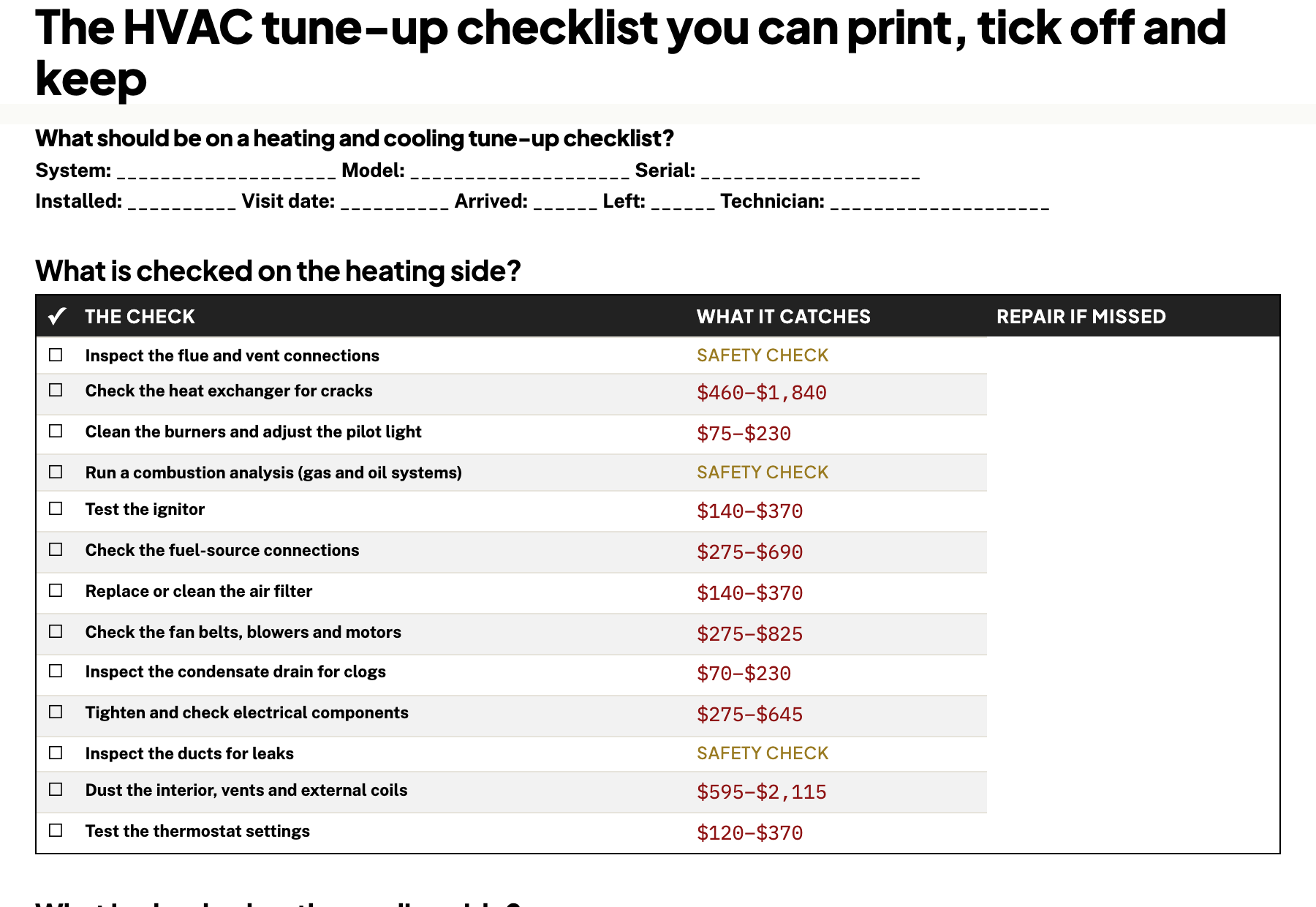
System: ____________________ Model: ____________________ Serial: ____________________
Installed: __________ Visit date: __________ Arrived: ______ Left: ______ Technician: ____________________
What is checked on the heating side?
The heating side carries 13 checks, and three of them are safety checks rather than maintenance. Each row below names the check, the failure it is looking for, and what that failure costs to repair where you live.
| ✓ | The check | What it catches | Repair if missed |
|---|---|---|---|
| ☐ | Inspect the flue and vent connections | A blocked or disconnected flue vents combustion gas into the house. This is a carbon-monoxide check, not a cost question — it has no repair price because the outcome is not a repair. | Safety check |
| ☐ | Check the heat exchanger for cracks | A cracked heat exchanger ends the repair-or-replace argument on safety grounds at any age. | $460–$1,840 |
| ☐ | Clean the burners and adjust the pilot light | Soot from dirty burners coats the flame sensor, and the furnace starts locking out mid-cycle. | $75–$230 |
| ☐ | Run a combustion analysis (gas and oil systems) | Combustion drifting out of adjustment raises carbon-monoxide output before it raises the bill. The instrument reading is the only way to see it, and there is no part to price. | Safety check |
| ☐ | Test the ignitor | A hot-surface ignitor that is cracked or drawing wrong fails on the first cold night, not during the visit. | $140–$370 |
| ☐ | Check the fuel-source connections | A leaking connection or a drifting gas valve shows up as short cycling and a smell before it shows up as a failure. | $275–$690 |
| ☐ | Replace or clean the air filter | A clogged filter starves airflow until the high-limit switch trips, and the switch is what gets replaced. | $140–$370 |
| ☐ | Check the fan belts, blowers and motors | A blower running against restriction or on worn bearings burns out its motor. | $275–$825 |
| ☐ | Inspect the condensate drain for clogs | A condensing furnace makes water. A blocked drain backs it into the cabinet and onto the floor. | $70–$230 |
| ☐ | Tighten and check electrical components | A loose connection arcs, and the control board is usually what the arc takes with it. | $275–$645 |
| ☐ | Inspect the ducts for leaks | Duct leakage is measured in lost airflow, not in a failed part. Sealing is priced on our duct repair page. | Safety check |
| ☐ | Dust the interior, vents and external coils | Dust bonds to a wet evaporator coil and stops coming off with a brush. | $595–$2,115 |
| ☐ | Test the thermostat settings | A thermostat reading two degrees wrong makes the system run longer for the same room temperature. | $120–$370 |
What is checked on the cooling side?
The cooling side carries 9 checks, and it is a different visit rather than a shorter version of the heating one — six of the nine have no heating equivalent. The refrigerant charge and the condenser coil are the two that decide whether the system still delivers its rated capacity.
| ✓ | The check | What it catches | Repair if missed |
|---|---|---|---|
| ☐ | Clean the evaporator and condenser coils | A dirty condenser coil cannot reject heat, head pressure climbs, and the compressor is the part that fails at the end of that chain. | $735–$2,575 |
| ☐ | Check and adjust the refrigerant charge | A system running undercharged is a system with a leak, and the charge is the symptom being topped up. | $185–$550 |
| ☐ | Clear the condensate drain line | A blocked drain either trips the float switch or finds the ceiling below the air handler. | $70–$230 |
| ☐ | Test the run capacitor | A weak capacitor is the most common reason a system that ran in May will not start in June. | $110–$370 |
| ☐ | Measure the blower motor's amperage | Amp draw above the nameplate rating is a motor announcing its failure while it still runs. | $460–$2,115 |
| ☐ | Lubricate motors and moving parts | A dry condenser fan bearing seizes, and the compressor then runs with no airflow over it. | $275–$550 |
| ☐ | Tighten electrical connections | Pitted contactor points weld shut or stop closing, and the outdoor unit stops answering the thermostat. | $140–$320 |
| ☐ | Replace or check the air filter | Restricted airflow freezes the evaporator coil, and a coil that has iced repeatedly does not clean up. | $595–$2,115 |
| ☐ | Test the safety switches and system controls | A float switch or high-pressure cutout that has been bypassed shows up as water damage or a dead compressor, not as a part on an invoice. | Safety check |
A heat pump earns both columns, because the same equipment heats and cools. Filter changes sit on both lists and are the one item on either that belongs to the homeowner — see air filters and MERV ratings for the interval and the rating to buy.
What does skipping each check actually cost?
Every priced row above is the repair that check exists to prevent, taken from the same 2-source cost baseline our AC repair cost and furnace repair cost pages publish, and moved to your state by the same multiplier our repair-or-replace calculator uses. In Tennessee the 18 priced checks add up to $4,995 to $16,510 of exposure; nationally the same set runs $5,430 to $17,950.
That total is exposure, not savings, and the difference is the honest part. A tune-up does not prevent every failure on the sheet, and no visit prevents a part from eventually wearing out. What it changes is when the fault is found: a weak capacitor discovered in March is an appointment, and the same capacitor discovered in July is an emergency call at the after-hours rate. Against that, a tune-up costs $70 to $200 — roughly what one diagnostic visit costs, which is the comparison our tune-up cost page works through in full.
Four of the 22 checks carry no price at all, and that is deliberate rather than an omission. A blocked flue, a drifting combustion adjustment, a leaking duct run and a bypassed safety switch do not produce a part on an invoice — they produce a carbon-monoxide risk, a bill that climbs quietly, lost airflow and water damage. Publishing a number beside them would be inventing one.
Why the figures move by state: parts are national commodities and labour is not, so a state's price level is mostly the labour and overhead wrapped around the same component. We measured that across all 51 states in our HVAC repair cost by state study, and the sourcing rules behind every band are set out in our methodology.
How do you know the tune-up actually happened?
You know it happened by the clock and by four numbers. A thorough tune-up on one system runs 60 to 120 minutes — two 2026 pricing sources put a proper visit at 60 to 90 minutes and three more put it at one to two hours, which is as close to a consensus as this figure gets. Write the arrival and departure time on the sheet, because it is the one measurement you can take without any equipment.
The arithmetic is what makes the time meaningful. Cleaning a condenser coil properly takes fifteen to twenty minutes on its own. Clearing and flushing a condensate line takes ten. A combustion analysis needs the unit at steady state before the reading is valid, which is several minutes of running before anything is written down. Checking and tightening electrical connections means the panel comes off. Those four tasks fill most of an hour before anyone has looked at the charge, which is why a fifteen-minute visit cannot have included them, whatever the invoice says.
Which four readings should you ask for?
Ask for the four checks whose result is a number, because a number is the only part of the visit that survives after the van leaves. Request them before the technician packs up — each takes a moment during the visit and is unobtainable afterwards.
Two numbers that say whether the charge was measured or estimated.
The reading that shows the system was run and measured rather than looked at.
The comparison is the point: a number with nothing to compare it to proves nothing.
The only line on the invoice that is a safety result.
Suction and head pressure, in psi: ______________________________
The temperature split across the indoor coil, in degrees: ______________________________
Amp draw on each motor, against the nameplate rating: ______________________________
The combustion or carbon-monoxide reading, in parts per million, on gas and oil systems: ______________________________
Arrived: __________ Left: __________ Total on site: __________
Found / recommended: ______________________________________________________
________________________________________________________________________
A written summary with those readings on it does double duty: it is how you verify the visit, and it is the maintenance record a parts warranty asks for years later. If the invoice says only "system serviced, operating normally", nothing on it can be checked.
What does a very low advertised price tell you?
A tune-up advertised far below the $70 to $200 band is usually priced to get a technician through the door rather than to cover the work. The pattern is documented, and it is visible in the same places that publish tune-up checklists: one contractor page in our own research set publishes a detailed 22-point checklist and advertises a $39 furnace tune-up beside it. Homeowners describe the outcome in near-identical language — a technician "in and out in five minutes", a visit where the technician "didn't do anything", and in one account a $100 visit followed seven days later by a failed fan motor and capacitor that a real inspection measures directly.
None of that makes a low price dishonest by itself, and this is not a reason to distrust a contractor. It is a reason to hold the sheet and the clock, and to ask what the price includes before the appointment rather than after it. Our guide to choosing an HVAC company covers the licence, insurance and quote checks that come before this one, and what to check before you call covers the faults worth ruling out yourself first.
Which items are yours, and which are theirs?
Nine tasks on this list are genuinely yours, and they are the reason a well-kept system arrives at its annual visit needing less work. They divide by how often they are due rather than by difficulty: three monthly, three quarterly, three once a year.
- MonthlyLook at the filter and change it when it greys over
One to three months is the working interval, and a filter costs $10 to $30. It is the single maintenance task with the largest effect for the smallest amount of money.
- MonthlyKeep three feet clear around the indoor unit
Stored boxes against a furnace or air handler restrict return air and become a fire question near a combustion appliance.
- MonthlyWalk past the outdoor unit and clear what has blown into it
Leaves, grass clippings and cottonwood seed mat across the condenser coil, which is the surface the whole cooling cycle rejects heat through.
- QuarterlyRinse the outdoor coil from the outside with a garden hose, power off at the disconnect
Water from outside in, never a pressure washer, and never with the unit live. Bent fins and wet electronics both cost more than the cleaning saved.
- QuarterlyFlush the condensate line
A cup of distilled vinegar down the cleanout keeps the biofilm from closing the line. It takes under five minutes and it is the failure that damages ceilings.
- QuarterlyVacuum the supply registers and the return grille
Dust that never enters the duct never reaches the coil.
- Once a yearBook the professional visit before the season starts
Early autumn for heating, early spring for cooling. Booking ahead means a fault is found on an appointment rather than on the night it fails.
- Once a yearPhotograph the model and serial plate on both units
Those two numbers are what a warranty claim, a part order and an accurate quote all start from.
- Once a yearFile the written report from the visit
Many manufacturers require documented annual professional maintenance to honour the parts warranty.
Which tasks need a technician?
Five tasks on the professional list are not a matter of confidence or care — they need instruments, a certification, or both. The reason is stated below in each case, because "leave it to the professionals" is not a reason.
- Combustion analysis
- It needs a calibrated analyser in the flue, and the reading it produces is a carbon-monoxide measurement.
- Heat-exchanger inspection
- A crack is found with a camera and a pressure or flame-pattern test, usually with the burner assembly out.
- Any refrigerant work
- Handling refrigerant requires EPA Section 608 certification. Recovering, charging and leak-searching are all inside that rule.
- High-voltage testing
- Capacitors hold a charge after the power is off, and the measurements that matter are taken with the unit energised.
- Sealed-system diagnosis
- Reading superheat and subcooling against the manufacturer's chart is what separates a low charge from a failing metering device.
What changes if you have a heat pump, boiler or mini split?
Three systems carry checks the two lists above do not, and 8 extra rows cover them. Published tune-up checklists almost universally describe a gas furnace and a central air conditioner and stop there, which leaves the owner of a boiler or a ductless system holding a sheet that half applies. Each block below names the checks that exist only on that system, priced the same way.
What does a heat pump visit add?
A heat pump both heats and cools, so it runs all year and earns two visits rather than one. It also carries two components no furnace or air conditioner has. It adds 2 checks to the lists above, and the parts behind them are priced on our heat pump repair page.
| ✓ | The check | What it catches | Repair if missed |
|---|---|---|---|
| ☐ | Reverse the system and confirm it changes mode | A reversing valve that sticks leaves the system stuck in one mode, most often discovered on the first cold morning. | $460–$1,105 |
| ☐ | Run the defrost cycle and time it | A failed defrost board lets the outdoor coil ice over solid, and the system then heats with the auxiliary strips at several times the running cost. | $185–$550 |
What does a boiler visit add?
A boiler moves water rather than air, so nothing on the airflow half of the checklist applies and three pressure-side checks replace it. It adds 3 checks to the lists above, and the parts behind them are priced on our boiler repair page.
| ✓ | The check | What it catches | Repair if missed |
|---|---|---|---|
| ☐ | Check system pressure and the expansion tank charge | A waterlogged expansion tank sends pressure through the relief valve every heating cycle. | $185–$735 |
| ☐ | Cycle each zone valve | A zone valve that stops opening leaves one part of the house cold while the boiler reports itself satisfied. | $160–$460 |
| ☐ | Check the circulator pump and listen to the bearings | A failing circulator stops moving heat, and the boiler short cycles on its own high limit. | $275–$1,010 |
What does a mini split visit add?
A ductless system has its blower, its coil and its drain inside the room, priced per head, and its refrigerant joints are field-made rather than factory-brazed. It adds 3 checks to the lists above, and the parts behind them are priced on our mini split repair page.
| ✓ | The check | What it catches | Repair if missed |
|---|---|---|---|
| ☐ | Clean the blower wheel and the drain pan in every head | A ductless drain pan sits above a finished wall, and the blower wheel is the part that holds the biofilm. | $70–$460 |
| ☐ | Leak-check the flare fittings at both ends of the line set | Flare joints are made by hand on site, which makes them the leak point a ductless system has and a central system does not. | $230–$920 |
| ☐ | Read the inverter board's error history | The board logs faults the homeowner never saw, and it is also the most expensive control part on the system. | $140–$735 |
What should you do before the technician arrives?
Five things, and they change what the visit is able to cover. Clear a working path to both units and move whatever is stored against them. Photograph the model and serial plate on the indoor and outdoor equipment. Find the written report from the last visit. Note the system's age. Write down any symptom you have noticed and, more usefully, when it happens — on start-up, on the hottest afternoon, only overnight.
One honest sort before you book: a system that is failing right now needs a repair visit, not a tune-up. A tune-up is a scheduled inspection and cleaning, and a technician who arrives for one quotes the repair separately. If the system is not heating, not cooling, tripping its breaker or making a noise that started suddenly, book a diagnostic call instead — our service call cost page covers what that fee is and when it gets credited toward the repair. If the system runs but the question is whether it is worth keeping, our repair-or-replace guide settles that first.
How do you print or download the checklist?
Use the print button at the top of this page, or download the PDF. Neither asks for anything. There is no form, no email field and no business-focus dropdown between you and the file — which is worth stating plainly, because the two most visible tune-up checklists on the web both sit behind a six-field business form, and the two after those want an app signup.
The printed sheet drops the explanatory column and keeps the instrument. Page one is the record header and both check lists with their repair figures. Page two is the per-system additions and ruled space for the four readings, the arrival and departure times, and what the technician found. It is designed to come back from the visit with writing on it.
The record header asks for six things — system, model, serial, install date, visit date and technician — plus arrival and departure times. Those are the fields a parts-warranty claim asks for later, and they are the ones the technician-facing sheets leave out in favour of voltage and phase.
Licensed CC BY 4.0 — print it, hand it out, put it on your own site with attribution. Suggested citation: HVAC Service Call (2026). "HVAC Tune-Up Checklist." Retrieved from https://hvacservicecall.com/maintenance/tune-up-checklist/. If you run a maintenance plan and want to know how the visits and the pricing compare, that is our maintenance agreements page.
Tune-up checklist questions, answered
Eleven questions, taken from the ones the published tune-up checklists are themselves asked, and answered from the same data the sheet above renders from.
How long should an HVAC tune-up take?
Between 60 minutes and 2 hours on a system in reasonable condition, and around 90 minutes for a thorough visit on a single system. Published figures agree on that band: two 2026 sources put a proper visit at 60 to 90 minutes and three more put it at one to two hours. A visit that ends in fifteen minutes has not included coil cleaning, a drain clear, a combustion analysis and an electrical check, because those four tasks alone fill most of an hour.
What is the difference between an HVAC service, a tune-up and an inspection?
An inspection looks and reports. A tune-up inspects, then cleans, adjusts and tests — the cleaning is the difference, and it is where the efficiency comes back. A service call is a different product entirely: it is a diagnostic visit for a system that is already failing, billed as a diagnostic fee. The three terms are used interchangeably in advertising, so ask which one you are buying before you book.
What should be on the invoice after a tune-up?
Numbers. suction and head pressure, the temperature split across the indoor coil, amp draw on each motor, the combustion or carbon-monoxide reading — plus what was cleaned and what was found. A written summary with readings on it is the record a warranty claim asks for later, and it is the only part of the visit a homeowner can verify after the van has gone.
Is an HVAC tune-up worth the money?
A tune-up runs $70 to $200, and HomeGuide puts the 2026 average at $130. The 18 priced checks on this sheet are looking for failures that cost $5,430 to $17,950 nationally to put right, and no single visit prevents all of them. The honest case is narrower and still favourable: the visit costs about what one diagnostic call costs, it moves the discovery of a fault from a failure to an appointment, and it keeps the maintenance record a parts warranty asks for.
Should you book a tune-up in spring or in autumn?
Both, if the house has separate heating and cooling equipment: early spring for the cooling side, early autumn for the heating side. One visit a year covers one side properly. A heat pump is the exception that needs two visits regardless, because the same equipment runs in both seasons.
Can you skip a tune-up if the system seems fine?
A system that seems fine is the normal condition for most of the failures on this sheet. A weak run capacitor, a cracking ignitor and a coil losing capacity all read as "fine" until the day they do not. The stronger reason not to skip it is the warranty: many manufacturers require documented annual professional maintenance to honour the parts coverage.
Does a tune-up lower your energy bill?
Cleaning a coil and correcting a charge return the system toward the efficiency it was rated at, so a neglected system improves and a well-maintained one has little to gain. We publish no percentage figure for the saving, because the honest answer depends entirely on how far the system had drifted, and the published percentages we found are not sourced well enough to repeat.
How does a dirty air filter affect the system?
It restricts return air, which is the input the whole system is sized around. On the heating side the high-limit switch begins tripping; on the cooling side the evaporator coil ices. Both of those are on this sheet with the repair priced, and the filter that prevents them costs $10 to $30.
At what age do you stop maintaining a system and replace it?
Maintenance stops being the deciding question once a repair quote crosses roughly a third of what replacing the system costs, which is the point our repair-or-replace guide runs the arithmetic on with your state's own replacement band. A cracked heat exchanger ends the argument at any age, on safety rather than economics.
Is this checklist really free, and can I republish it?
Yes, and yes with attribution — the sheet is licensed CC BY 4.0. There is no form, no email field and no company field between you and the file. Print it from this page or download the PDF.
How do you use the checklist during the visit?
Print it, hand nothing over, and tick items as you watch. Ask for the four readings before the technician packs up, because they take a minute during the visit and are unobtainable afterwards. Then file the sheet with the written summary — the two together are the maintenance record.